What choosing Luoyang changes
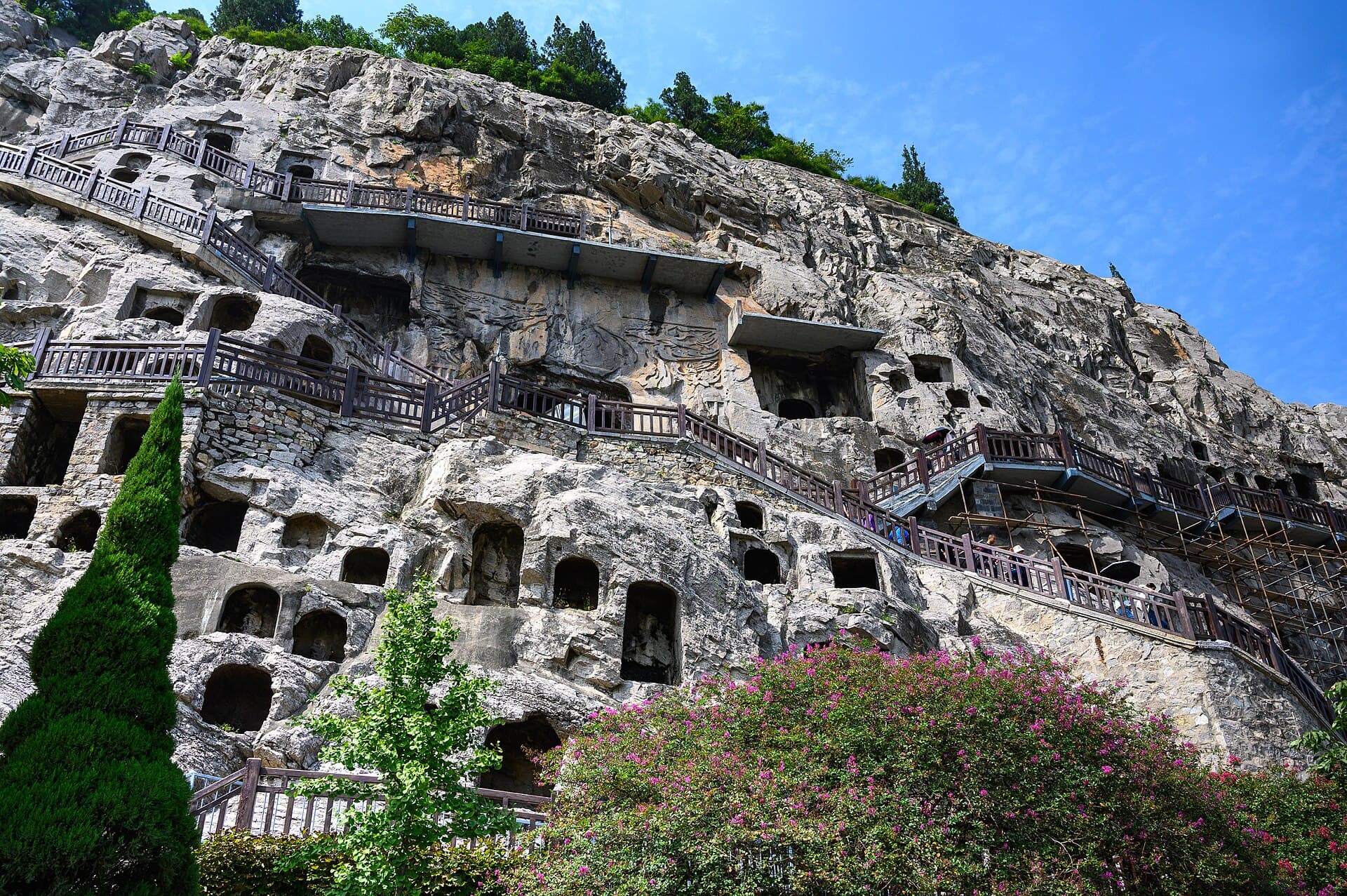
Luoyang is one of China's great ancient capitals, and the Longmen Grottoes alone preserve more than two thousand caves and niches, tens of thousands of Buddhist figures, stupas, and inscriptions along the Yi River. For the Planner, treat two to three days as the working allocation and use “Longmen Grottoes in depth” as the first fixed block.
The city's museums, White Horse Temple, old streets, Eastern Zhou context, Tang associations, peony culture, and Henan food place that monumental sculpture within a much longer historical landscape. The constraint that changes this route is practical: English support is thinner than in China's largest cities, outer sights require careful routing, and April's peony season adds crowd and hotel pressure.
See & do
Landmarks & experiences
Start with Longmen's sculptures, then add museum context and a temple visit.
Suggested time on site. Transfers and queues are extra.
Longmen Grottoes
Study Northern Wei and Tang Buddhist carvings along the Yi River cliffs.
3-5 hrOutskirtsSouthern Luoyang, beside the Yi RiverLuoyang Museum
Explore objects from the city's long history as an imperial capital.
2-3 hrCityNietai Road, Luolong DistrictWhite Horse Temple
Walk the courtyards of a temple central to China's Buddhist history.
1.5-3 hrOutskirtsEast of central Luoyang
Longmen has long exposed walks and steps; check museum reservations before visiting.
Food
Local dishes & food streets
Soup shops and tangy banquet dishes give Luoyang a distinctive Henan food culture.
Peony-style shredded radish soup
Fine radish shreds in a tangy soup, a signature of the water-banquet tradition.
Luoyang beef soup
Beef broth with sliced meat, often eaten with flatbread for breakfast.
Bufan soup
A sour, peppery soup served over thin mung-bean pancakes.
Where to eatTry the old city around Lijing Gate and streets near Xigong Small Street.
Water-banquet portions suit groups; ask about meat stock even in radish or pancake soups.
Stay
Neighborhoods & trade-offs
| Area | Why stay here | The trade-off |
|---|---|---|
| Lijing Gate and the old city | Evening walks, soup shops and older city streets. | Longmen and the high-speed station require cross-city travel. |
| Quanshun and Kaiyuan Lake | A modern Luolong base for restaurants, the museum district and trips south. | Less historic street life; the old city needs a separate journey. |
Transport
Arrival & getting around
- Getting in
- Luoyang Longmen Station serves high-speed trains; it is not the grottoes. Luoyang Station is nearer the older center.
- Around the city
- Use metro between central districts, then a bus or taxi for the final leg to outlying heritage sites.
- Beyond the city
- Longmen lies south and White Horse Temple east; plan separate outings rather than assuming they share a route.
Transfer times are not yet verified. Check door-to-door timings for your exact airport, station or day-trip route.
Budget
Rooms, meals & transport
| Expense | What to budget for |
|---|---|
| A room for two | City hotels can offer good value, but peony-season demand changes the picture. |
| Meals | Soup breakfasts and noodles are economical; order selected water-banquet dishes instead of a full feast for two. |
| Local transport | Metro helps in town; allow for the final ride to Longmen and the trip to White Horse Temple. |
Based on two adults sharing a standard double room, three meals and local transport. Admission, intercity travel, airport transfers and personal spending are extra. Check hotel rates for your travel dates before setting a daily budget.
Longmen and temple admission, optional scenic transport and seasonal gardens need separate allowances.
When to go
Weather & crowds
- Jan
- Feb
- Mar
- Apr
- May
- Jun
- Jul
- Aug
- Sep
- Oct
- Nov
- Dec
April draws peony visitors; May and September-October are useful alternatives for heritage walks.
Bloom timing varies. Summer sun and winter cold can make Longmen's exposed route demanding.
Essentials
Preparation & local advice
- English & navigation
- High-speed rail and major heritage sites provide basic structured information, but drivers, local restaurants, and smaller attractions often need translation. Before adding “Longmen Grottoes in depth,” save the Chinese names used in that route and the full address of the return station or hotel; that is the useful language input for this particular plan.
- Before you go
- Save Longmen Grottoes for the attraction and Luoyang Longmen Station for the railway station; pack water and shoes suited to stone steps.
- On the ground
- Do not touch the cliff carvings; allow time to look closely instead of rushing between viewpoints.
Make time for Luoyang.
2-3 days, at your pace.
A 3-day itinerary
A 3-day Luoyang itinerary
Longmen Grottoes in depth
Arrive early, follow the main cliff sequence without rushing, spend time at Fengxian Temple, and cross the river only if time, weather, and walking ability allow. For “Longmen Grottoes in depth,” keep Day 1 as the fixed block and add another reservation only when its local transfer and likely meal stop fit the same district.
Luoyang Museum and ancient-capital context
Use Luoyang Museum to build a chronological framework, then add a central archaeological, old-city, or food experience rather than another remote monument. For “Luoyang Museum and ancient-capital context,” keep Day 2 as the fixed block and add another reservation only when its local transfer and likely meal stop fit the same district.
White Horse Temple and a focused finish
Visit White Horse Temple with enough travel time and respectful dress, or substitute a seasonal peony garden or another heritage site that matches your interests. For “White Horse Temple and a focused finish,” keep Day 3 as the fixed block and add another reservation only when its local transfer and likely meal stop fit the same district.
Questions about Luoyang
How many days do I need in Luoyang?
Allocate 3 days. Day 1 should cover this exact block: Arrive early, follow the main cliff sequence without rushing, spend time at Fengxian Temple, and cross the river only if time, weather, and walking ability allow. Add white horse temple and a focused finish only on Day 3; do not steal time from the first block to fit it.
What is the best time to visit Luoyang?
April is famous for peonies but busy; May and September to October often provide comfortable conditions with less single-event pressure. For this 3-day version, keep “Longmen Grottoes in depth” on the clearest suitable day: Arrive early, follow the main cliff sequence without rushing, spend time at Fengxian Temple, and cross the river only if time, weather, and walking ability allow.
Is Luoyang manageable without speaking Chinese?
High-speed rail and major heritage sites provide basic structured information, but drivers, local restaurants, and smaller attractions often need translation. On Day 1, save the Chinese names for “Longmen Grottoes in depth” before leaving the hotel: Arrive early, follow the main cliff sequence without rushing, spend time at Fengxian Temple, and cross the river only if time, weather, and walking ability allow.
Where is the best area to stay in Luoyang?
A metro-connected base between the central city and Luoyang Longmen Station balances evening food access with straightforward heritage transfers. For this 3-day route, test the door-to-door trip from that base to “Longmen Grottoes in depth” before booking.
Sources & editorial notes
- UNESCO: Longmen Grottoes
Longmen's Yi River cliff setting and Northern Wei and Tang Buddhist sculpture only; not entry terms, travel times or other city venues. Checked 2026-08-31.
- ChinaTravel.tools editorial city dataset
Maintained editorial scoring and practical city-planning notes for travelers.
- Henan Provincial Government — Luoyang museums and Longmen
Provincial government context for Luoyang Museum, Longmen and the city's museum-heavy planning value.